Cash For Work FAQs

Here you will find answers to the most common questions about the Cash For Work Program (CFW).

The TEP-CFW (Temporary Employment Programme - Cash for Work) strengthens the resilience of Palestine Refugees in the West Bank by providing temporary income opportunities and on-the-job training opportunities as well as sustaining access to basic social services. It helps uphold dignity, while also contributing to the Agency’s essential services. 


To apply, you must: 

  • Be a registered Palestine refugee with UNRWA. 
  • Be aged 18–55 years old. 
  • Be currently unemployed. 
  • Live near or have access to the UNRWA or CBO installation where the project is being implemented.  
  • Agree toTEP-CFW  terms and conditions. You can see the terms and conditions in the contract.  
  • Only applications submitted via the official TEP-CFW online platform at eUNRWA will be considered.  
  • Only one household member can participate at a time. Others may apply and their applications will be considered 12 months after the completion of the initial contract. Members of the same household are family members registered on the same refugee card.  
  • If you have served previously under any TEP-CFW Program, you need to wait 12 months after your last TEP-CFW contract to be eligible again. Kindly note that re-selection is not automatic, but you need to apply again to be considered.  

  • PA employees 
  • UNRWA SSNP (Social Safety Net) beneficiaries 
  • Immediate family of UNRWA staff members 
  • Current MoL (Ministry of Labour) Cash-for-Work beneficiaries 


Priority Given To: 

  • Female-headed households 
  • Households with 5 or more members 

NOTE Married to Non-Refugee (MNR) Families: Only the MNR woman is eligible, husband and grown-up children are not eligible. 

UNRWA seeks to sustain and strengthen diversity and to ensure equal opportunities, as well as an inclusive working environment, for everyone we work with and for. Applications are encouraged by all qualified candidates regardless of background. Women candidates are encouraged to apply, as well as persons with disabilities.  

If you are a person with a disability and you expect you may face challenges during the hiring process, you can indicate it in your application form on our recruitment platform. Reasonable accommodation for candidates with disabilities will be provided to the best extent possible and as needed upon request. 

There are only a limited number of work opportunities available, and not all eligible applicants can be guaranteed a placement. If you are interested in working with UNRWA in “regular positions”, please also have a look at the job openings advertised at UN Careers website. (link connecting to the website for United Nations jobs) 

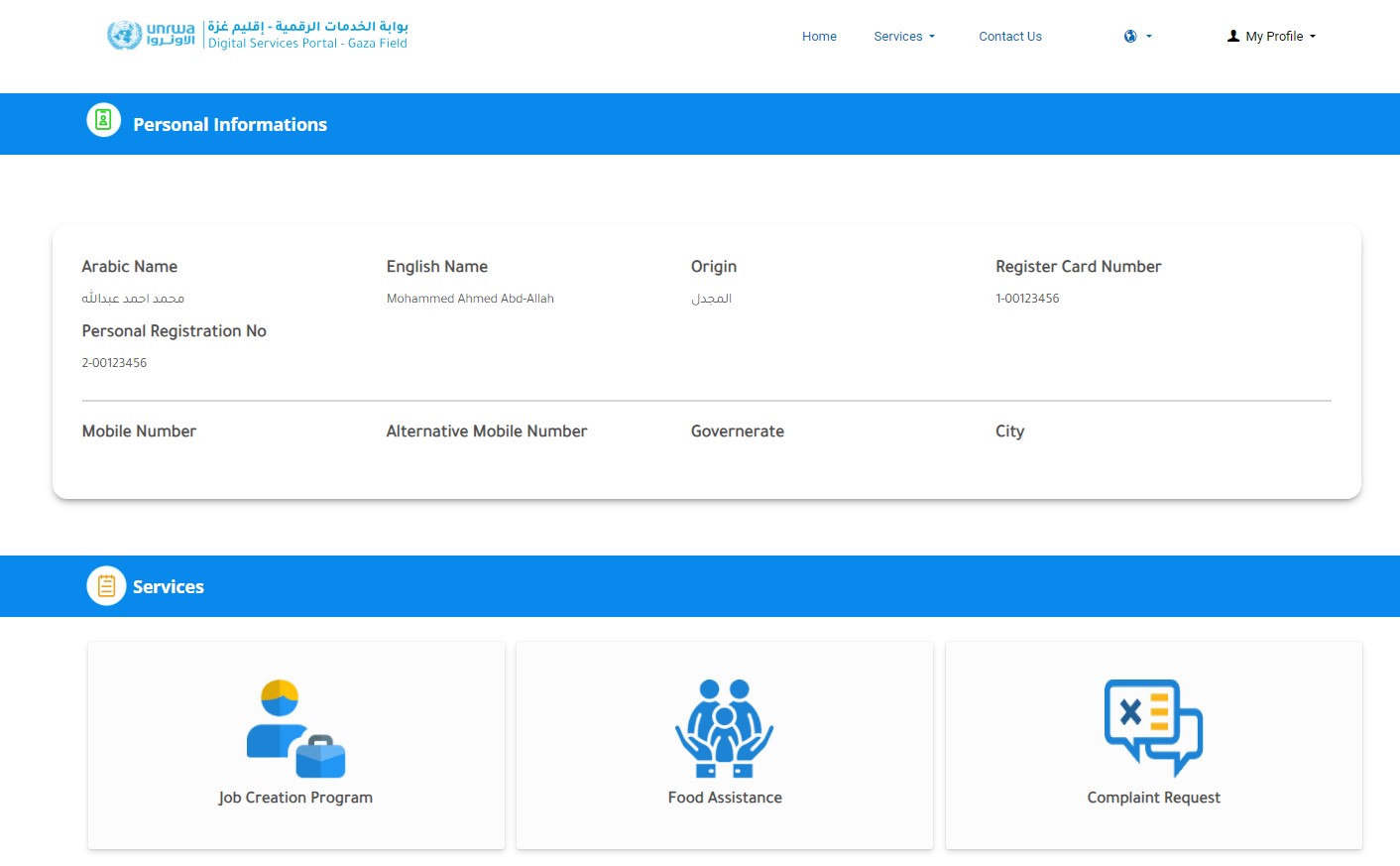
  1. You need an eUNRWA account. 
  2. Visit the TEP-CFW platform in Arabic or English. 
  3. For help, visit the CCSO office, where trained TEP-CFW assistants can support you 
  4. Apply at: [UNRWA - Home] (link to UNRWA website page for Cash for work program)  


Participants in the TEP-CFW are selected according to predefined eligibility and vulnerability criteria. There is only a limited number of work opportunities available.  

No favoritism or special requests are accepted. 


Skilled Workers 

  • Have prior technical or professional experience in a specific field. 
  • May hold university degrees, diplomas, vocational certificates, recognized professional skills or other recognized qualifications. 
  • Usually hold vocational training certificates or proven work history. Examples: electricians, plumbers, painters, smithery, tilers, carpenters, IT technicians, administrative assistants. 
  • Typically engaged in tasks that require specialized knowledge or training.  

TVET Graduates 

  • TEVET Graduates from both UNRWA and non-UNRWA training centers are eligible. 
  • Can work in UNRWA installations, CBOs, and the private sector. 
  • Offered a four-month contract, similar to skilled beneficiaries. 
  • Must have graduated within the past three years (not more than three years). 

 Unskilled Workers 

  • Do not require prior technical experience or formal qualifications. 
  • Perform general labor or support tasks with on-the-job guidance. 
  • Examples: cleaners, sanitation workers, gardeners, messengers. 
  • Usually engaged in short-term or basic support roles. 

  • Unskilled workers are paid a fixed amount of 1880 ILS per month. This is in accordance with the minimum wage in Palestine (1880 ILS). 
  • Skilled workers and TVET graduates are paid a fixed amount of 2157 shekels per month. 
  • The duration of the contract and salary are fixed and agreed upon with the donor (KfW). They cannot be changed by UNRWA or renegotiated. 
  • The salary amount is determined according to the Palestinian minimum wage and the Cash Working Group standards and is applied equally regardless of gender or disability status in line with principles of non-discrimination and equal opportunity. 

  • All payments are paid via PalPay within the first 15 days of the following month.  
  • PalPay operates as a third-party payment service through which beneficiaries receive their funds. Each beneficiary receives an SMS containing a unique code linked to their ID number. The beneficiary then visits an authorized PalPay partner shop in their area, presents their ID, provides the received code, and collects the cash.  

Yes! TEP-CFW is a Temporary Employment Programme - Cash for Work program. You must carry out your assigned tasks during the contract. The Applicant must attend and perform work on each business day of UNRWA and/or the seconded organization throughout the duration of the contract agreement.  

The Applicant’s working hours shall commence at 07:30 hours, unless otherwise agreed in writing by UNRWA and/or the seconded organization. Working hours shall be minimum 7.5 hours per day (including lunch, other breaks) according to the Palestinian Authority (PA) Ministry of Labor regulations. 

Adherence to the agreed work schedule is mandatory. Any unapproved absences may lead to salary reductions in line with programme policies. 

Sick leave must be formally reported and justified. Under the TEP-CFW , only pre-approved sick leave supported by a valid medical certificate from a licensed practitioner will be considered certified. Supervisors may approve up to two working days of sick leave per month, maximum of six days over a three-month period or eight days over four months, at their discretion. For further details, please refer to the sick leave provisions outlined in your contract.  

No. Placement is based on the project needs. Requests to be placed at specific schools or UNRWA sites cannot be honored. The work sites are selected based on workplans developed for each position and location.  

Assignments may take place in:  

  1. In UNRWA Installations inside and outside camps. 
  2. At Community-Based Organizations (CBOs) including refugee Local Services committees. 
  3. In the private sector; this applies only to TVET graduates. 

Please check the latest information about the assignments available on eUNRWA. 

No. TEP-CFW workers are project beneficiaries, not UNRWA employees. They do not have access to staff systems or entitlements. If you had worked previously under the daily paid contract with UNRWA and would now be selected for a  TEP-CFW assignment, that would not be a continuation of the same contract.  

 TEP-CFW beneficiaries are covered by (work accident insurance only ). it only applies to work-related incidents that occur during official working hours or while performing assigned duties. A general health insurance is not provided. 

You can contact UNRWA for any questions, feedback, or complaints by visiting the nearest Camp and Community Service Officer in the camps or one of our UNRWA Area Offices: 

  • Ramallah Area Office – Beitunia, 6th floor 
  • Nablus Area Office – Rafidia, 6th floor 
  • Hebron Area Office – Hebron City, Mar Luqa Building 

No. All humanitarian assistance is free of charge. If anyone asks you for money, gifts, or favors, we encourage you to report it immediately.️  

UNRWA does not tolerate fraud, misconduct, or sexual exploitation and abuse. Misconduct can also be, for example, harassment, discrimination, violence including against children, or breaches of neutrality. If you have seen or experienced any of these involving UNRWA staff, partners, or service providers, you have the right to report it. UNRWA takes all reports seriously and treats them confidentially. You can also report anonymously (without your name). Anonymous reporting may limit the potential for an investigation. UNRWA will always review your report and take appropriate steps.  


You can use any of the following for reporting: 

OR Report to the Director or Speak to trained UNRWA staff  

Always tell the truth. You have an obligation to be truthful and to provide all relevant information to UNRWA. This includes an obligation not to omit information that may be relevant to your application and to provide all necessary details. Intentionally misrepresenting identity, family composition, providing false information or hiding information is considered fraud. Giving false details (like fake names, locations, or needs) can lead to delays for selection processes, investigations and sanctions or even removal from the project application site. 

If you made a mistake or need to update your information, please inform our staff at UNRWA offices. 

It’s possible to correct mistakes and correct your information. Honest updates help us assist you better. 


Please Wait..